
'Only he can bring change in India that all of us have been dreaming of since we saw America for the first time when our plane touched down at JFK airport.' Narendra Modi's friends in New York and New Jersey travel down memory lane and remember a simple man with great ambition. Sheela Bhatt/Rediff.com tracks down the Modi bhakts, who knew since his first visit in 1993 that he was destined for bigger things.
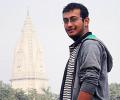
Shubham Kumar Gautam, son of a farmer and a Super 30 student, recounts how, in a journey laced with perseverance, grit and determination, he achieved what seemed impossible.
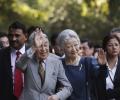
In the media frenzy over inconsequential issues, the visit of the Emperor of Japan to India has been pushed to the margins of public discourse. Colonel (retd) Anil Athale explains the great historical and political significance of the visit.

The 'secularists'are more adept at the politics of intense and alarmingly exaggerated fear-mongering, as this kind of politics provides easy votes of Muslims without making them answerable for the concrete issues of poverty, unemployment, lawlessness, and of basic needs like roads, electricity, etc, which is exactly how Nitish Kumar was defeated in the elections, says Mohammad Sajjad.

In dramatic scenes, Umar Khalid, the Jawaharlal Nehru University student who had been untraceable after being accused of sedition, returned to the campus late on Sunday evening. Khalid turned up at JNU's administration block, where hundreds of students began to gather, and gave a rousing speech just shy of 14 minutes, insisting that he would stand his ground and asked that all students unite against the attacks on our country. This is what he had to say.

Rediff.com's Love Guru has answers to all your relationship problems.

A young IT grad jailed for visa fraud committed by his agent, gives an insider's view of life in jail.

Pablo Bartholomew, the legendary Indian photojournalist whose searing images from the Bhopal gas tragedy stunned a nation's conscience 30 years ago, speaks to Vaihayasi Pande Daniel/Rediff.com.

'Modi, focused on youth and their aspirations, has articulated a truly disruptive change: One of hope, of duties rather than rights, of standing up to the world instead of being bullied by it,' says Rajeev Srinivasan.

Were river experts excluded from IIT consortium on the Ganga River Basin Management Plan? Rashme Sehgal reports.
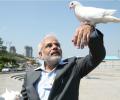
Rediff.com's Sheela Bhatt unearths some never-told-before details of Narendra Modi's early life. Read on!

'I have never seen anybody disliked more as prime minister than Modi.' 'What is interesting is in his prime ministership, no matter whatever happens in any corner of India, Modi is blamed for it.' 'Modi has not suspended any Constitutional liberties. No Opposition leader has been put in jail... Modi is not Hitler.'

'No one talks about the Mumbai riots anymore, though like Delhi 1984, the guilty have not been punished. In Gujarat, many powerful leaders of the state's ruling party are in jail for their role in the riots... In Mumbai, only one politician of the Shiv Sena, a former MP, was convicted of hate speech, along with two other Shiv Sainiks, one of whom was a corporator and the other a junior functionary... So why the apathy? Could it be because despite these statistics and the widely-publicised findings of the Srikrishna Commission, what remained in public consciousness was the violence by the Muslims, thanks to a highly efficient Sena propaganda machine? There's no demand for it, but would an SIT probe into the closed cases of the Mumbai riots help today?' The fadeout of Mumbai's riots from public debate can be called a triumph of the communal State, argues Jyoti Punwani.

'AAP's real value must be measured not by the number of Lok Sabha seats it wins in the election -- which may not exceed 10 or 15 -- and not even by the number of votes it takes from the BJP, but by its ability to deflate Modi's superhuman '56-inch chest' image and the charisma so assiduously manufactured around him by the corporate-controlled media.'

Despite criticism of a lack of transparency and communication from the Modi-led government, BJP leaders point to "good beginnings" on several fronts to defend its performance. Sheela Bhatt/Rediff.com reports.

Salman Khan's latest, Jai Ho, didn't set the cash registers ringing, and one reason could be that his diehard Muslim fans were put off by his support for Narendra Modi, says Syed Firdaus Ashraf.

'I believe Modi mentioned Balochistan only to embarrass Pakistan and also divert attention toward the situation in Kashmir.' 'I think from now on, India intends to raise Balochistan whenever Pakistan brings up Kashmir or upsets them on the issue of terrorism.' 'Balochistan is the least developed of Pakistan's four provinces. It is the least educated and least economically developed. People are agitated that a region so rich in mineral resources and a sea-port is still so poor.' Baloch political analyst Malik Siraj Akbar on why the province wants freedom from Pakistan.

The journey of Abhijit Avasthi, the former national creative director of Ogilvy & Mather, is as amazing as it is unbelievable. Read on!

'For so long as the rulers of Pakistan remain committed to confronting and vanquishing India, they will sustain delusions, breed terrorists, and export them.'

'The obsession of the Pakistan army with India leads to several destabilising things. Support for the Taliban in Afghanistan. Support for groups like the Lashkar-e-Tayiba, that have attacked India. Every time you get an attack like that there is a possibility of a war. And then the build up of the their nuclear arsenals. Chances of a nuclear weapon landing in the hands of a terrorist group, or a nuclear war breaking out, are tiny. But they are higher here than anywhere else in the world.'

Born and abandoned in Mumbai, reborn in Sweden, Erika Sandberg says she is Indian on the outside but feels Swedish on the inside. Vaihayasi Pande Daniel narrates her tale.

Muzzling NGOs is unbecoming of a democracy. Self-confident democracies encourage, indeed applaud, the involvement of citizens' associations, including NGOs, in social and political decision-making and development planning. Instead, our paranoid government bullies and terrorises them, says Praful Bidwai.

'Many sepoys fought with distinction, winning some of the first Victoria Crosses to be awarded to Indians; and indeed, as in any army fighting under such inhumane conditions -- standing in the freezing sludge, with shrapnel tearing through bodies and being subjected to gas attacks -- some buckled under pressure.'

Only three percent of Indians pay income tax; our tax-GDP ratio is among the lowest in the world. This must change. Our elites must realise that India's poverty has damaging consequences for them, and that they can help decrease it. The food security bill, with all its limitations, will hopefully contribute to generating such awareness, says Praful Bidwai.

Rediff.com reproduces the 1997 feature about Laxman, his passion for crows, and of course, his genius.

A theory that is doing the rounds is that with election nearing, this depreciation of the rupee will allow politicians of all hues to bring back their ill-gotten wealth.

Very few old-style RSS workers-turned-leaders have survived Narendra Modi's political ambush in state politics. Harin Pathak's end closes the chapter for Modi who started his post-2002 riots journey with a new mix of profit-centric development and middle class-pleasing commerce, technology-driven communication with voters, and an unspoken Hindutva that speaks only through posturings and symbols. Rediff.com's Sheela Bhatt reveals the real reasons for the Modi-Pathak rupture.
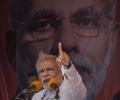
'He is an extraordinarily focused, determined, full-time politician, who from the moment he wakes up to the moment that he goes to sleep is looking at the job in hand.'
 © 2026 Rediff.com - Advertise with us - Disclaimer - Privacy Policy - Sitemap - Feedback - About us - Terms of use - Grievances